
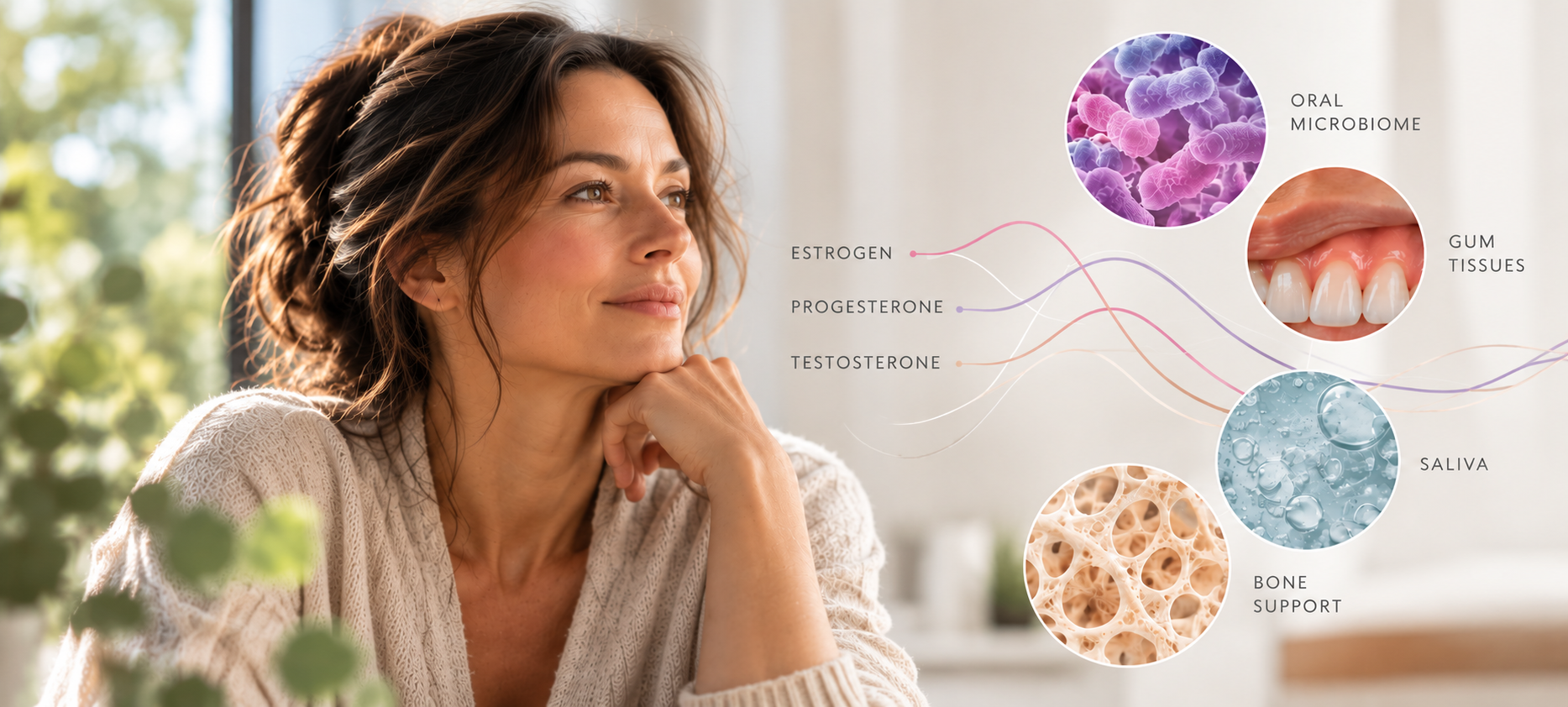
Why your mouth can change when your body does
Maybe your gums have started to bleed when you floss. Maybe your mouth feels drier than it used to, or your teeth are suddenly very sensitive. Changes like these can show up during pregnancy, after a baby, or through perimenopause and menopause. It’s common for them to appear alongside changes elsewhere in your body, and there’s a reason.
Your mouth responds to hormones. Hormones act throughout your body, helping regulate tissues, immune activity, inflammation, and bone. Your mouth is part of that system, so hormonal changes at different life stages can change how your mouth feels and responds.
Hormones are only one piece of the picture. Your oral health also depends on your medications, health conditions, smoking, nutrition, oral hygiene, genetics, and age. This page explains where hormones fit in and what to do when something changes.
Key Takeaways
- Your mouth responds to sex hormones, just as the rest of your body does.
- Hormone shifts can affect four areas: your gums, saliva, jawbone, and oral microbiome.
- Hormonal changes alter the environment in your mouth. They don’t determine, on their own, whether you develop oral disease.
- Your life stage is useful context, but any change in your mouth still deserves a proper evaluation.
Hormones Can Change How Your Mouth Responds
Hormones don’t usually cause oral problems directly. Instead, they change how your gums, saliva, jawbone, and oral microbiome respond to what’s already happening around them. That’s why two women going through the same transition can have very different experiences.
Your gums and immune response
What you might notice: Gums that look red, swollen, or tender, or that bleed more easily when you brush or floss.
Why hormones may play a role: Hormones can affect how your gums respond to plaque, the sticky film of bacteria that builds up on your teeth.
Worth mentioning to a provider: Bleeding gums may be common, but that doesn’t mean they’re normal. If your gums bleed regularly when you brush or floss, it can be a sign of inflammation and is worth discussing with your dental provider.
[Learn more about gums →]
Saliva
What you might notice: A dry or sticky mouth, a mouth that just feels different, or a greater need to sip water throughout the day.
Why hormones may play a role: Hormonal changes may affect your saliva.
Worth mentioning to a provider: Dryness that keeps going, or that comes with other changes in your mouth.
[Learn more about saliva →]
Bone
What you might notice: Changes in the bone that holds your teeth in place may not be obvious at first. Signs to watch for include teeth shifting, new spaces between teeth, or teeth that feel loose.
Why hormones may play a role: Estrogen helps maintain healthy bone throughout your body, including your jawbone.
Worth mentioning to a provider: Any of the signs above are worth getting checked.
[Learn more about jawbone health →]
The oral microbiome
What it is: The community of bacteria and other microbes that live in your mouth.
What you might notice: Usually nothing. You may not feel these changes directly.
Why hormones may play a role: Hormones may influence the balance of microbes in your mouth. Shifts in that balance can be associated with changes in gum health, inflammation, and other oral conditions.
Worth mentioning to a provider: Because these changes are hard to feel, tell your dentist about any new gum or mouth changes.
[Learn more about the oral microbiome →]
Hormones Are One Part of the Picture
Oral health is shaped by much more than hormones. Changes in your mouth can also come from:
Your body
- Genetics
- Metabolic health
- Immune health
- Oral microbes
- Medications
- Age
- Existing oral disease
Your daily life
- Smoking
- Diet
- Stress
- Sleep
- Oral hygiene
What This Means for You
If something has changed in your mouth, it can mean that something has changed in your body. Hormones can be one clue, not the whole answer.
So the most useful question isn’t simply:
“Are my hormones causing this?”
It’s:
“What factors in my health, life stage, medications, oral environment, and daily life may be interacting right now?”
A few ways to start answering it:
- Note when the change began. Did it line up with pregnancy, a new baby, or shifts in your cycle or menopause symptoms?
- Note what else changed around the same time. Think medications, stress, sleep, or diet.
- Bring both to your appointment. Together they give your provider a fuller picture.
Your mouth is part of your health story, not a separate system.
When to Talk to a Dentist or Healthcare Provider
If oral changes persist, get worse, or concern you, talk with a provider. Signs worth a visit include:
- Gums that keep bleeding
- Teeth that feel loose or seem to be shifting
- Dry mouth that doesn’t go away
- Sores that don’t heal
Who to see: Start with your dentist or primary care provider. Your OB-GYN or a menopause-informed clinician can also help, especially if the changes began during a hormonal transition.
Mention the hormone connection, even if your provider doesn’t ask. It’s useful context for the bigger picture of your health. You might say:
“My gum changes started when my periods became irregular.”
Why Life Stage Matters
Hormonal environments change throughout life. Pregnancy, postpartum, perimenopause, and menopause aren’t biologically identical, and neither are their possible effects on your mouth.
Where are you right now?
- [Perimenopause, Menopause & Oral Health →] Dry mouth, bone, and midlife shifts.
- [Pregnancy & Oral Health →] Gum changes and what’s common.
- [Postpartum & Oral Health →] Taking care of your oral health after pregnancy.
Sources
- Cornejo Ulloa PE, Krom BP, Schoonmade LJ, van der Veen MH. Sex steroid hormones: an overlooked yet fundamental factor in oral homeostasis in humans. Front Endocrinol. 2024;15:1400640. doi:10.3389/fendo.2024.1400640.
- Cornejo Ulloa PE, Krom BP, van der Veen MH. Sex Steroid Hormones as a Balancing Factor in Oral Host Microbiome Interactions. Front Cell Infect Microbiol. 2021;11:714229.
- Butera A, et al. Oral Health Across the Menopausal Transition: Biological Pathways, Clinical Implications, and Future Perspectives. J Clin Med. 2026;15:5757.
- Lopes Cardoso I, et al. Impact of female hormonal changes throughout life on oral health: A scoping review. J Dent Sci. 2026;21:31–48.
- Holtkamp A, et al. Sex-Specific Oral Health: A Narrative Review of Hormonal Influences and Disease Patterns. Dent J. 2026;14:147.